Toilet water rising when you flush, instead of draining away, usually means the blockage is not in the toilet at all. It is further down the line. Here is how to tell the difference in about sixty seconds.
A toilet that rises and then slowly empties has a restriction. One that rises and stays there has a blockage. One that rises while another fixture gurgles has a main line problem, which is a different job entirely.
Quick answer
- Rises, then drains slowly: partial restriction. Often yours to fix.
- Rises and stays: blockage in the toilet or its branch.
- Rises while another fixture gurgles: the main line. Stop using water.
- Do not flush again. Every flush adds another four or five litres.
What Is Actually Happening When the Water Rises
A flush is not powered. It works on gravity and volume. The cistern dumps four or five litres into the bowl in about three seconds, and that surge is what pushes waste through the trap and into the branch drain.
If anything downstream slows that water down, it arrives faster than it can leave, and the bowl becomes a holding tank.
So the rise tells you there is a restriction. It does not tell you where. That is what the next sixty seconds are for.
The 60-Second Test: Flush Once, Then Listen
Do this before you touch a plunger.
- Flush once. Once only. Every extra flush adds another four or five litres to a bowl that already cannot empty.
- If it is climbing towards the rim, stop the water. Lift the cistern lid and push the flush valve down by hand, or turn the isolation tap behind the cistern clockwise until it stops.
- Wait sixty seconds and watch the level. Do not touch anything.
- Now run the basin tap for thirty seconds, then the shower. Stand near the toilet and listen.
| What you see or hear | What it means | What to do |
|---|---|---|
| Level drops slowly on its own; basin runs freely | Partial restriction near the toilet | Usually yours to fix |
| Level does not move at all; other fixtures are fine | Full blockage in the toilet or its branch | Plunger, then a plumber if it does not shift |
| Toilet gurgles when you run the basin or shower | The shared line downstream is blocked | Stop using those fixtures. Book a drain clear |
| Basin or shower also slow, or floor waste bubbles | Main line | Stop using water. Call now |
Not sure what you just heard?
Call R&G on 0420 146 747 and describe it. Licensed Sydney plumbers, $0 call-out fee, and if it is a ten-minute fix you can do yourself, we will tell you that on the phone.
When It IS the Toilet (and You Can Fix It Yourself)
Two causes sit inside the fixture itself. Rule both out before you call anyone.
Partial obstruction in the trap
The trap is the S-bend moulded into the base of the pan, and it is the narrowest point in the system.
The usual culprits are wet wipes, paper towels, tissues, sanitary products and cleaning blocks that have broken loose. Sydney Water reports that non-flushable wet wipes are behind roughly three-quarters of wastewater blockages, and that only the three Ps belong in a toilet.
A flange plunger, the type with a soft rubber lip that folds out rather than the flat cup you would use on a sink, shifts most of these. Seat it so it seals against the outlet and work it in slow strokes, because fast strokes push water past the seal.
If two or three rounds do nothing, stop. Past that point, you are compacting it rather than moving it, and it becomes a job for a blocked toilet plumber.
Low cistern water level
This gets mistaken for a blockage constantly. If the cistern is not filling to its waterline, the flush lacks the volume to clear the pan, and the bowl looks like it is filling when it is really just failing to empty. Check the level against the moulded fill line inside the cistern.
The bucket test settles it. Pour five to eight litres into the bowl in one steady go from about waist height. If it clears, your line is open and the cistern is the problem.
When It Is NOT the Toilet: Four Signs It Is the Main Line
If you see any of these, the toilet is fine, and the line it empties into is not.
1. Other fixtures gurgle when you flush
Water going down the pipe pushes a column of air ahead of it. When the line is clear, that air escapes up the roof vent. When it is blocked, it comes back through the nearest water-filled trap instead: the basin, the shower or the floor waste. Sydney Water lists a gurgling toilet or floor drain among the signs of a blockage not to ignore.
2. More than one fixture is slow
One slow fixture is a local problem. Two or more share a drain, and that drain is the problem.
3. Water rises in the shower or bath
Waste appearing in a fixture you did not use means the blockage is downstream of both. Water backs up to the lowest opening it can find, which in most Sydney homes is the shower.
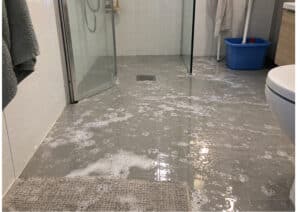
Stop running water anywhere in the house. Every litre has to go somewhere, and it will end up on the bathroom floor. If it is already overflowing, that is an emergency plumbing call rather than a Monday morning one.
4. It has happened before and cleared itself
The strongest signal of the four, and the one most people ignore because the problem went away.
A blockage that clears on its own has not been removed. It has softened and washed through, and whatever caught it is still there. It will catch the next thing sooner.
Roots are the common cause in older Sydney homes, where clay sewer lines were laid in short lengths with joints that were never watertight.
One thing worth knowing before you call anyone: you are responsible for the wastewater pipes on your property up to where they connect to Sydney Water’s network. If your neighbours have the same problem, or it overflows while nobody is using water, call Sydney Water on 13 20 90 first.
What NOT to Do
Do not flush again to see whether it has cleared. It is the commonest way a manageable blockage becomes a floor to clean.
Do not pour caustic drain cleaner into a full bowl. It sits diluted in standing water, never reaches the blockage, does nothing to roots, and leaves a hazard for whoever opens the pipe later.
Do not hire a jetter for a suspected main line. High pressure in an unlined clay pipe with an unknown fault can turn a blockage into a collapse.
Do not keep using the rest of the house. The dishwasher, washing machine and shower all empty into the same line.
How a Plumber Diagnoses It: Locate, Clear, Camera, Decide
The order matters as much as the steps.
Locate. We open the inspection point, usually near the boundary, and establish whether the blockage sits upstream or downstream of it. That tells us whether this is a branch drain or the main line.
Clear. An electric eel for roots and solid obstructions, or high-pressure jetting for fat and debris.
Camera. A drain camera run down the cleared line shows what caused it and marks its depth and position. Roots at a joint, a bellied section and a rag on a junction produce the same symptom and need three different fixes. That footage is what turns a clear into a drain repair when the pipe itself has failed.
Decide. A one-off obstruction is finished. A structural fault comes back, and the footage tells you whether that means a repair, a section of relining, or something to monitor.
Clearing a recurring blockage without a camera is a temporary fix sold as a permanent one. If it has happened before, ask to see the footage.
Water still rising, or backing up into another fixture?
Call R&G and tell us what the other fixtures are doing. Licensed and insured, covering the North Shore, the Hills and Western Sydney, with a $0 call-out fee and a fixed price before any work starts. See how we find and fix blocked drains across Sydney.
Frequently Asked Questions
Why does the water rise and then slowly go down?
A partial restriction rather than a full blockage. The line is still open, just narrowed, usually by fat and paper build-up or by roots that have not closed the pipe completely. It will keep narrowing, and the gap between incidents will keep shortening.
Is it safe to flush again to see whether it has cleared?
No. The second flush adds another four or five litres to a bowl that cannot empty. Wait for the level to drop, or use the bucket test instead.
My toilet water is rising, but it isn’t clogged. What else could it be?
Three things. A blocked vent, which stops air from escaping and makes the bowl burp and rise. A partial blockage further down the shared line rather than in the toilet. Or a cistern that is not filling properly, which gives a weak flush that looks like a rise. The 60-second test separates them.
Can a blocked toilet fix itself?
It can appear to. Soft blockages wash through, so the symptom disappears while the cause stays put. If a toilet has backed up more than once, treat it as a recurring fault and get a camera down it.
Will a plunger make it worse?
Not on a toilet blockage, provided you use a flange plunger and work slowly. What it will not do is help with a main line problem. If other fixtures are gurgling or slow, plunging just moves water around inside a line that has nowhere to drain to.
Do I actually need a drain camera, or is that an upsell?
For a one-off blockage with an obvious cause, no. For one that has happened before, or where the plumber cannot tell you what caused it, yes, because otherwise you are paying to clear the same fault repeatedly.