Do this now, in this order
1. Open doors and windows on your way past them. 2. Do not touch any switch, including a light switch. 3. Get everyone outside. 4. From outside, away from the building, call Jemena on 131 909, the gas network for Sydney, 24 hours.
If there is a fire risk, or anyone feels unwell, call 000 first.
If you can smell gas inside your house, the first job is to get everyone out without creating a spark, and the second is to call the gas network rather than a plumber.
Jemena attends gas leaks across Sydney 24 hours a day and does not charge to make the network side safe. A licensed gas fitter comes after that to find and repair the fault and relight your appliances.
What Not to Touch, and Why
Natural gas needs an ignition source. Almost everything on this list is one, and most do not look like one.
- Any electrical switch. Turning a light off makes a spark inside the switch exactly as turning it on does. Leave them as you found them.
- Your phone, while you are still inside. Take it with you and use it outdoors, away from the building.
- A torch. Same reason. The switch is the problem, not the beam
- Anything with a flame. No matches, no lighter, no cigarette, anywhere on the property
- Appliances, fans, extraction, the rangehood. Do not switch anything on to clear the air. Open windows instead
- The garage roller door, if the meter is in the garage. It is an electric motor
Open doors and windows as you pass them. Ventilation is the one thing that helps, but do not stop to open them all.
Turning the Gas Off at the Meter
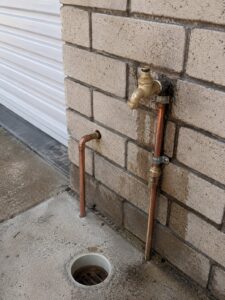
If your gas meter is outside and you can reach it without going back indoors, turn the gas off there. It is usually a lever or tap on the pipe into the meter, and a quarter turn closes it.
If the meter is inside, in a cupboard or in the garage, leave it. Jemena can isolate the supply at the street,t and that is what they are for.
Once the gas is off, leave it off. Do not turn it back on to test whether the smell has gone, because every appliance in the house is now sitting with an open gas valve and no flame.
Who to Call, and in What Order
Three numbers, and the order depends on one question: is anyone in danger?r.
| Situation | Call |
|---|---|
| Fire, a very strong smell, or anyone feeling unwell | 000, then the gas network |
| Gas smell inside, outside, or in the street | Jemena 131 909, 24 hours |
| Leak found and made safe, appliances off | A licensed gas fitter to repair and relight |
The split matters because the two halves have different owners. The network up to and including your meter is Jemena’s. The pipework through your house and every appliance on it is the property owner’s, and that is where most leaks actually are.
So Jemena will come, confirm gas is escaping and isolate it. They will not repair your internal pipework or your cooktop. That is the gas fitter’s job, and it is licensed work in NSW.
If you are not sure which network you are on, the emergency number is printed on your gas bill. Jemena covers Sydney; parts of regional NSW sit with Australian Gas Networks on 1800 427 532.
The Gas Problem That Has No Smell
Natural gas has no natural smell either. The rotten egg odour is an additive, put there so leaks get noticed, and it works.
Carbon monoxide is the opposite. It is produced when a gas appliance burns incompletely; it has no smell, no colour and no taste, and you cannot detect it without a detector.
That is why a gas appliance can be dangerous in a house where nothing smells wrong. The early signs are in the people, not the air: headache, nausea, dizziness and unusual tiredness, often in more than one person, and often better when everyone has been outside for a while.
If that is what you are describing, get everyone out into fresh air, leave the appliance off and seek medical advice. Have it tested before anyone uses it again. Unflued gas heaters and old gas wall furnaces are the ones to be careful about.
If You Are Renting, This Is an Urgent Repair
A gas leak is named outright on the urgent repairs list in NSW. The NSW Government’s urgent repairs page, citing the Residential Tenancies Act 2010, lists it as its own item.
Make the property safe first and tell the landlord or agent second. Nothing in a tenancy agreement requires you to stand in a house that smells of gas waiting for someone to answer the phone.
Then notify them in writing and keep the message. If you cannot reach them and the repair cannot wait, you can arrange it and claim the cost back. The Tenants’ Union of NSW sets the limits: do not spend more than $1,000, and the landlord must repay reasonable costs within 14 days of your notice and receipts. You will need to show it was not your fault, that you tried to contact them, gave them a reasonable chance, and used a licensed tradesperson. If they do not pay, you have three months to apply to NCAT.
Keep the gas fitter’s report. On a gas job, it is the document that matters most.
After It Is Made Safe
Once the supply is isolated, the leak still has to be found, and that is a test on the pipework rather than a sniff around the kitchen.
The common culprits are the flexible connector behind a cooktop or gas heater, a corroded fitting at an appliance, a failed appliance valve, and on older properties the internal pipework itself. Relighting appliances afterwards is part of the job, because an appliance relit badly is how you end up with the carbon monoxide problem above.
All of it is licensed gas fitting work in NSW. Ask to see the licence, and for the compliance paperwork when the job is done.
If the smell comes and goes rather than filling the house, that is still a leak and still needs testing. Our guide to gas leak warning signs covers the slower version, where something is wrong for weeks before anyone is certain.
Gas network first, then U.S
Call Jemena on 131 909 while there is gas escaping. Once it is isolated, call R&G on 0461 330 531 to find the fault, repair it and relight your appliances properly. $0 call-out fee, 24 hours.
Frequently Asked Questions
Who do I call if I smell gas in Sydney?
Jemena on 131 909, from outside the building, 24 hours a day. They are the gas network for Sydney, and they do not charge to attend a leak and isolate the supply. Call 000 first if there is a fire risk or anyone feels unwell. A licensed gas fitter comes afterwards to find and repair the fault.
Can I use my phone if I smell gas?
Not inside. Take it with you, get outside and away from the building, and call from there. Distributor guidance says not to use a telephone in a space where gas is escaping and also says to call immediately, and those two instructions are sequential rather than contradictory. Get out, then call.
Should I turn the gas off at the meter?
Yes, if the meter is outside and you can reach it without going back indoors. A quarter turn of the lever or tap on the inlet pipe closes it. If the meter is inside, in a cupboard or in the garage, leave it and let the network isolate the supply at the street. Do not re-enter a building that smells of gas for any reason.
Why can I smell gas near the stove but nowhere else?
A localised smell at an appliance usually points to that appliance rather than the house pipework, most often the flexible connector behind it, a corroded fitting or a failed valve. It is still a leak, and it still needs a licensed gas fitter to test and repair it. A brief whiff as a burner lights is different and normal.
Is a gas leak an urgent repair in a NSW rental?
Yes. A gas leak is named on the urgent repairs list under the Residential Tenancies Act 2010. Make the property safe first, then notify the landlord or agent in writing. If you cannot arrange them,m you can arrange the repair and claim back reasonable costs up to $1,000, payable within 14 days of your notice and receipts, provided it was not your fault and a licensed tradesperson did the work.
Gas isolated, now what
We are licensed for gas fitting as well as plumbing, and we test, locate and repair gas leaks and relight appliances across the Upper North Shore, the Hills District and the Parramatta and Ryde corridor. Fixed price before anything starts, no call-out fee. See gafittingig, or emergency plumbing if something else has gone wrong at the same time.