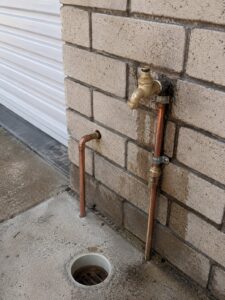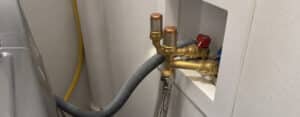
Check these two valves first. Both are free
The tap at your water meter and the isolation tap feeding your hot water unit. Sydney Water’s own advice is to make sure both are fully open, not just open. A valve left three-quarters closed looks open and behaves like a restriction.
Still low? Call R&G on 0461 330 531. $0 call-out fee.
Low water pressure in a Sydney home is usually one of four things, and the cheapest of them is a valve somebody forgot to reopen.
Work through it in order. Two of the four cost nothing to rule out, and the expensive one is last for a reason.
Start With the Two Valves Sydney Water Names
Sydney Water’s own guidance for a property with low pressure is to check two things before anything else. Both are on your side of the meter, and both are free.
First, the tap at the water meter that controls flow to your property. Open the meter box at the front boundary and make sure it is turned fully on, not partly. A half-open valve delivers water perfectly well at one tap and collapses the moment two are running.
Second, any tap controlling flow to your hot water unit or other devices. Same test, same reason.
This happens more than you would think, usually because someone turned the water off for a job and reopened it by feel rather than all the way. If the pressure dropped around the time any plumbing or renovation work was done, check this before reading any further.
Is It Everywhere, One Tap, or Only Hot
This is the question that narrows it, and the answer is usually in the pattern rather than the severity.
| What you have | Where to look |
|---|---|
| Low at every tap, hot and cold | The meter valve, a failing pressure-reducing valve, or the incoming pipework |
| Low on hot only, cold is fine | The hot water unit, its isolation valve, or a gravity-fed system working as designed |
| Low at one tap or shower only | A blocked aerator or shower rose, or that tap’s cartridge. Not a pressure problem |
| Fine alone, poor when two outlets run. | A restriction somewhere in the supply. Narrowed pipe, partly closed valve, or corrosion |
| Dropped suddenly, nothing changed | A failed valve, a leak, or network work in the street |
The one-tap row is worth doing yourself. Unscrew the aerator from the spout, or take the shower rose off, and look at what comes out. Scale and grit collect in both, and five minutes with vinegar fixes what looked like a whole-house problem.
The useful way to tell us is the “but”. The pressure is fine in the kitchen but hopeless in the shower. Or it is fine first thing but gone when the washing machine runs. Either sentence halves the diagnosis.
The Three Things Sydney Water Blames
Sydney Water runs a programme reducing pressure in parts of Greater Sydney with a history of pipe breaks, and in explaining it they name the three things that cope badly with less pressure. It comes from the utility, which is what makes it the most useful cause list published anywhere.
Their words: “some instantaneous hot water systems, corroded galvanised pipes, or existing pressure reducing valves may work less effectively, and you may need to upgrade them.”
Instantaneous hot water. A continuous flow unit needs a minimum flow to fire and keep firing. Marginal pressure gives you lukewarm water that goes cold when another tap opens. That is a hot water system matched badly to the pressure available, not a broken one.
Corroded galvanised pipe. Covered below, because it is the expensive answer.
An existing pressure reducing valve. If your property has one and the pressure fell off without anything else changing, that valve is the first suspect. They have a service life, and they fail in both directions, so the same part that causes other problems in older Sydney homes by letting too much through can equally choke the supply.
If your area has recently been through a pressure change, Sydney Water’s pressure management line is 1300 466 820. Worth asking before you spend anything on your own pipework.
Measure It Before You Spend Anything
Three minutes at your meter tells you whether this is a supply problem or a plumbing problem, and that decides who pays.
Sydney Water’s own method: turn off every tap and appliance, note the meter reading, open the front garden tap fully for exactly one minute, then read the meter again and subtract. The difference is litres per minute.
Sydney Water’s standard is a minimum of 15 metres head, roughly 147 kPa, measured at the point of connection to their main, and they say that equates to 18 litres a minute at the garden tap. Hit 18 or more,e and your supply meets their obligation, which means the problem is inside your boundary.
For context, the network average is 52 metres head, around 510 kPa, and most properties sit between 15 and 65 metres head. That spread is why a house that always felt strong can still be well inside the rules after a change.
Come in under 18 litres, and it is worth calling Sydney Water on 13 20 92 so they can check for a local problem or works in the street.
Fair to note their position: Sydney Water says reducing pressure does not mean less water, only that taps may need to run a little longer. True of volume. What changes is how fast it arrives, which is what matters to a shower and an instantaneous hot water unit.
Galvanised Pipe Is the Expensive Answer
Plenty of older Sydney properties still have galvanised steel supply pipe, and it fails from the inside out.
Corrosion builds up on the internal wall over decades and narrows the bore. The pipe looks sound from outside, and the diameter carrying water has halved. Pressure at the main is unchanged; pressure at your shower is not.
Two tells. The pressure has declined slowly over years rather than dropping one day. And it is dramatically worse when two outlets run at once, because a narrowed pipe cannot supply both.
There is no repair for it. The pipe gets replaced, and on a whole house that is real money, which is why it belongs at the end of this list and not the start. Rule out the valves, the aerators, and the hot water unit first.
When Low Pressure Means a Leak
A leak large enough to drop your pressure is large enough to be doing damage, so this is the one version worth acting on quickly.
The signs are a pressure drop alongside something else: an unexplained jump in your bill, ground that stays wet in dry weather, a patch of unusually green lawn, water seeping from under a path or slab, or a damp wall.
Any of those together with low pressure means water is leaving the pipe before it reaches the house, and leak detection will find it without digging the whole run.
Worth knowing that pressure problems and banging pipes are two sides of the same system. Pressure that is too high shortens the life of every joint, hose,e and appliance valve in the property, which is what causes banging pipes, and a pressure reducing valve that has failed can hand you either symptom depending on which way it went.
Do the bucket test before you call.
Litres in one minute from the front garden tap, and whether it is everywhere, hot only, or one outlet. Those two answers tell us whether this is an aerator, valve, ve or the pipe itself, before anyone comes out. Call R&G on 0461 330 531. $0 call-out fee.
Frequently Asked Questions
Why did my water pressure drop suddenly with nothing changed?
The three usual answers are a valve that is not fully open, a pressure reducing valve that has failed, or a valve that works in the street. Check the tap at your meter and the one feeding your hot water unit first, because both are free and both are common after any plumbing or appliance work. A sudden drop with wet ground or a higher bill points to a leak instead.
Why is my hot water pressure low but cold is fine?
Look at the hot side only. The isolation valve at the unit may not be fully open, a continuous flow unit may not be getting the flow it needs to fire properly, or the system may be gravity-fed and working exactly as designed. Sydney Water specifically names instantaneous hot water systems as one of the things that struggle when pressure is marginal.
What is normal water pressure for a Sydney home?
Sydney Water’s minimum obligation is 15 metres head, roughly 147 kPa, at the point of connection to their main. The network average is 52 metres head, around 510 kPa, and most properties sit between 15 and 65 metres head. That is a wide range, so a noticeable drop can still leave you comfortably within the rules.
How do I test my water pressure at home?
Measure flow instead, using Sydney Water’s method. Turn off all taps and appliances, read the meter, open the front garden tap fully for one minute, then read the meter again and subtract. 18 litres or more means your supply meets the 15 metre head standard, so anything wrong is inside your boundary. Under 18, call Sydney Water on 13 20 92.
Can old pipes cause low water pressure?
Yes, and galvanised steel pipe is the usual culprit in older Sydney properties. It corrodes from the inside, narrowing the bore over decades while looking sound from outside. The tells are a slow decline over years rather than a sudden drop, and pressure that collapses when two outlets run at once. Sydney Water lists corroded galvanised pipes among the causes of poor pressure. There is no repair, only replacement.
Find out what is actually restricting it
We test pressure and flow, clear and replace aerators, valves and cartridges, repair and replace pressure reducing valves, and replace corroded supply pipework across the Upper North Shore, the Hills District and the Parramatta and Ryde corridor. Fixed price before anything starts, no call-out fee. See emergency plumbing if the pressure has gone down or water is appearing somewhere it should not.