A blocked downpipe does not stop water from arriving. It sends it somewhere else. The gutter fills, spills over the edge, and runs down the wall instead of into the ground.
That is why the damage shows up far from the blockage, and why people fix the stain on the wall rather than the pipe that caused it.
Quick answer
- Gutter overflows in rain while other sections cope: the downpipe on that run is blocked.
- Tap the downpipe. A hollow ring means clear; a dull thud means packed. It works from the ground.
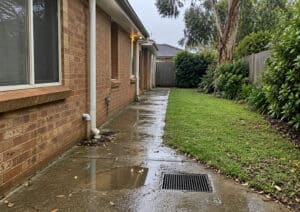
- Water pooling at the base means the blockage is at the bottom or in the pipe below it
- Do not go up a ladder to check. You can do the whole diagnosis below, standing on the lawn.
How to Tell From the Ground Which One Is Blocked
You do not need to see into the gutter. Four signs, all visible from the garden.
The gutter overflows during rain. The detail that matters is where. Water pouring over one section while the rest of the roof drains normally points at the downpipe serving that run.
Water runs down the outside of the downpipe. It is escaping at the top, at the gutter outlet, rather than going in. Look for a dark streak down the pipe even on a dry day.
Tap it. Work up from the base with a knuckle. A clear downpipe rings hollow. A packed one gives a dull thud, and the point where the sound changes is roughly where the blockage sits. The most useful thing on this page, and almost nobody knows it.
Look at the wall below. Staining, efflorescence on brickwork or peeling paint below a gutter line are records of water that has been going over the edge for a while.
Where the Blockage Actually Sits
Four places, and they are four different jobs.
At the gutter outlet. Where the gutter feeds the downpipe. Leaves, seed pods and roof grit mat over the opening. The most common by a distance, and the easiest to clear.
Inside the vertical pipe. Debris that got past the outlet and jammed at a bend. The tapping test finds this one.
At the base, where it enters the ground. Silt builds at the bottom of the vertical run, or the connection has been crushed by ground movement, a vehicle or landscaping.
Below the base, in the underground line. Not a downpipe problem at all. If the pipe is clear and water still backs up at the bottom, the fault is in the stormwater line beyond it, or the connection needs a drain repair.
What the Overflow Is Actually Doing
This is the part worth reading even if the overflow does not bother you.
Water against the wall and footings. A single downpipe carries the runoff from a large area of roof. Sending that volume down a wall storm after storm saturates the soil around the footings, and in the reactive clay common through the west and the Hills, that repeated wetting and drying is what moves footings and cracks brickwork.
Rot in the eaves and fascia. Water sitting in a full gutter is in constant contact with the fascia behind it. Timber takes years to fail and gives little warning before it does.
Water into the roof cavity. A gutter overflowing backwards rather than over the front edge goes under the roof edge instead, and shows up as a ceiling stain that gets blamed on the roof.
The weight. A gutter full of wet leaves and standing water is heavy enough to pull brackets loose and deform the gutter line.
Where it lands. Concentrated overflow erodes garden beds, undermines paving and feeds straight into backyard flooding after rain.
None of it happens in one storm. All of it happens over a few seasons, which is why blocked downpipes get left.
Why It Is Seasonal in Sydney
Two peaks worth planning around. Autumn leaf fall, which fills gutters over several weeks and is heaviest under mature deciduous trees. And the storm season, when a gutter that coped with light rain suddenly cannot. Most people discover a blocked downpipe during the first serious storm, which is the worst time to find out.
Eucalypts complicate it, because they shed bark and litter year-round rather than in one season. A property under gums needs checking more than twice a year.
So clear gutters and downpipes before the storm season rather than during it. Same job either way, but one version happens on a dry afternoon and the other in the rain with water already in the wall.
Found the blocked one?
Call R&G on 0461 330 531. Tell us where the sound changed when you tapped it, and we will know roughly what we are dealing with before we arrive. $0 call-out fee, fixed price before any work starts.
What You Can Check Safely, and What to Leave Alone
Everything in the first section of this page is done from the ground. Do all of it before anyone gets a ladder out.
Clear the base at ground level. Debris around the bottom of the downpipe, or in the grated pit it feeds, is safe to deal with.
Run a hose into the gutter outlet if you can reach it safely from solid ground. Water backing up rather than disappearing confirms it.
What to leave alone: the roof and gutter work from a ladder. Ladder falls are one of the more common serious injuries around Australian homes, and gutter clearing causes them, because it means reaching sideways at height on soft ground. A wet tile roof is worse again. The job is worth less than the injury.
Also leave alone: forcing a rod or hose down a blocked downpipe under pressure. If the pipe is cracked or the base connection has failed, you move the problem into the wall or the ground rather than clear it.
What a Plumber Does About It
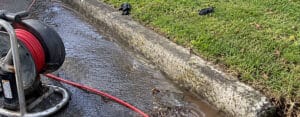
Clears the gutter, outlet and downpipe properly, with the right access equipment, and from the top rather than forcing debris down into the underground line where it becomes a bigger job.
Checks the base connection. Whether the downpipe actually enters a pipe, and whether that pipe is intact. Disconnected and crushed connections are common and invisible from above.
Tells you whether the fault is above or below ground. That decides everything else, and it is worth insisting on before agreeing to any work.
More on gutters, downpipes and roof plumbing across Sydney.
Frequently Asked Questions
How often should downpipes be cleared?
Twice a year suits most Sydney properties, timed before the storm season and after the main leaf fall. Under established gums or figs, more often, because they shed year-round rather than in one go.
Are gutter guards worth it?
They reduce how much gets into the gutter, and they are genuinely useful under heavy canopy. They do not remove the need to check, because fine debris and seed matter still pass through, and a guard that has itself become matted is worse than no guard at all.
The downpipe is clear, but water still pools at the bottom
Then the fault is below the downpipe: the underground stormwater line, or the connection where the downpipe meets it. Both are common where vehicles park over the connection or where landscaping has disturbed the ground.
Can a blocked downpipe cause damp inside the house?
Yes, and it is one of the more common causes of damp on an external wall. Water going over the gutter edge runs down the wall repeatedly, and rising or lateral damp gets investigated for months before anyone looks up.
Clear it before the storm season, not during it.
We clear gutters and downpipes properly, check the base connection while we are there, and tell you whether the fault is above or below ground. $0 call-out fee, fixed price before any work starts, across the North Shore, the Hills and Western Sydney. See how we handle roof plumbing and drains across Sydney.