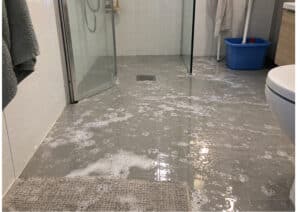
If your drains only back up when it rains, you do not have a blockage. You have stormwater getting into a wastewater line that was never meant to carry it.
That changes the answer. A blocked drain gets cleared. A line taking in rain gets repaired, and clearing it makes no difference.
Quick answer
- Only during or after rain: stormwater infiltration, not a blockage
- It is a structural fault. A crack, a damaged gully, or a wrong connection
- Clearing the drain will not fix it, and it will happen again at the next storm
- It is also a warning. A pipe taking in rain has an opening, and roots use the same openings
Sewer and Stormwater Are Separate for a Reason
Your property has two drainage systems. Wastewater from toilets, showers and sinks goes to Sydney Water’s sewer network. Rain from your roof, driveway and yard goes to a separate stormwater system discharging to the kerb.
They are kept apart because of volume. A single storm puts more water on an average roof in an hour than the household sends to the sewer in a week.
So when rain finds its way into the wastewater line, the line fills far beyond what it was designed to carry, and the surplus comes back up through the lowest opening it can find. That is why your shower or toilet misbehaves during a downpour and behaves perfectly the rest of the time.
It is treated as a fault to be repaired rather than an inconvenience. Sydney Water runs a program targeting it and identifies cracked private wastewater pipes and low-lying or damaged overflow relief gullies as the usual entry points.
The Four Ways Rain Gets In
1. A cracked or broken pipe. The most common. Groundwater rises during heavy rain and pushes in through any crack, open joint or root entry point. The same openings that let roots in let water in, which is why the two problems so often turn up together.
2. A damaged or low overflow relief gully. The grated gully outside your bathroom releases sewage into the yard if the line backs up, and it is supposed to sit above the surrounding ground. If landscaping has lowered it, or the ground has risen around it, surface water pours straight into the sewer every time it rains. A cracked or missing grate does the same.
3. A downpipe or surface drain connected to the sewer. Not permitted, and it still happens, usually from an old renovation. One downpipe plumbed into the wastewater line overwhelms it in any serious storm.
4. A missing or broken inspection opening cap. The capped access points sit at ground level, and an open or cracked cap in a low spot takes in surface water directly. The cheapest of the four to fix.
How to Tell It Apart From a Normal Blockage
| What you notice | What it points to |
|---|---|
| Only during or just after rain. Fine otherwise | Stormwater infiltration. A structural fault |
| Gets worse the longer the rain lasts | Infiltration. Volume is building faster than the line can clear |
| Resolves on its own within hours of the rain stopping | Infiltration. A real blockage does not clear itself |
| Slow or backing up in dry weather too | A blockage, possibly with infiltration on top of it |
| Neighbours affected at the same time | Possibly the network rather than your line |
Row three is the one people misread. A problem that clears a few hours after the rain stops feels resolved, so nothing gets done, and the same thing happens at the next storm. Nothing was fixed. The water stopped arriving.
If it happens in dry weather too, you may have both: a partial blockage that copes until rain adds volume. If your drains were gurgling before any of this started, that was the same line telling you earlier.
Why Clearing the Drain Will Not Help
Worth being direct, because this is where money gets wasted.
A drain clear removes material from inside the pipe. Infiltration is not material inside the pipe. It is water entering through an opening in it.
So a plumber can jet the line until it is spotless, and the next storm does the same thing, because nothing about the opening has changed. If you have paid to clear a drain twice and it still backs up whenever it rains, the diagnosis was wrong rather than the work.
In fairness, a line can have both, and clearing is a reasonable first step if nobody has looked inside yet. Clearing it a third time without a camera is not.
Only happens when it rains?
Call R&G on 0461 330 531. Tell us it is rain-triggered, because that changes what we bring and what we look for. $0 call-out fee, fixed price before any work starts.
What a Plumber Does to Find It
Checks the obvious first. Gully height and condition, the inspection opening caps, and whether any downpipe disappears into a sewer connection. A surprising number of cases end here, and cheaply.
Cameras the line. Cracks, open joints and root entry points are visible on footage, with the depth and distance of each marked. On a rain-triggered problem, this is not optional, because the fault is by definition invisible from the surface.
Traces the water if the camera is inconclusive. Running water into a suspected gully and watching the line, or using smoke or dye, finds a wrong connection that footage alone might not explain.
Then fixes the opening rather than the symptom. Raising or replacing a gully, capping an inspection opening, disconnecting a wrongly plumbed downpipe, or sealing the pipe.
What the Fix Usually Is
If it is the gully, the caps or a wrong connection: straightforward and relatively cheap. Raise the gully, replace a grate, cap an opening properly, or reroute the downpipe into the stormwater system where it belongs.
If it is the pipe, the opening has to be sealed. Relining is the usual answer on an older clay line, sealing every joint and crack in the lined section at once and stopping infiltration and root entry together. Our relining cost guide covers the numbers. If a section has collapsed or lost its grade, relining is not possible, and it becomes a drain repair.
Establish one thing before anyone is paid: whether the fault is on your side of the connection point at all.
Why It Is Worth Fixing Even Though It Only Happens Sometimes
It is a hole in your sewer line. Water getting in means waste can get out, and a line leaking into the soil is what attracts tree roots in the first place.
The opening gets bigger. Water moving through a crack carries soil with it,t and the void around the pipe grows, which is how a crack becomes a collapse. Nothing about it improves on its own.
And the day it overflows indoors, you have a contamination problem rather than a drainage one, and sewage coming up the shower drain covers the next thirty minutes.
If water is pooling in the yard rather than coming up indoors, that is a different system entirely, covered in backyard flooding after rain.
Frequently Asked Questions
It clears up on its own after the rain stops. Can I ignore it?
It will keep doing it, and the opening letting water in will get larger. The fault is also an escape route for waste and an entry point for roots, so the version where it only happens occasionally is still worth dealing with before it becomes the version where it happens indoors.
Could it be Sydney Water’s network rather than my pipe?
Possibly, particularly if neighbours are affected at the same time, or there is widespread flooding locally. Their fault line is 13 20 90; it is staffed around the clock, and the call is free, so it is worth ruling out before paying anyone.
Why did this start recently?
Usually because something changed at ground level or in the pipe. Landscaping that raised the soil around a gully, a new paved area sending more surface water to one point, or a crack that has finally opened enough to matter after years of ground movement.
Find the opening, not the blockage
A rain-triggered backup has a specific entry point at a specific distance, and clearing the line will not touch it. We camera it, show you where the water is getting in, and fix the opening. $0 call-out fee, fixed price before any work starts, across the North Shore, the Hills and Western Sydney. See how we handle blocked drains and pipe relining across Sydney.