If water is running right now
Go to the front boundary, find the meter box in the ground, and turn the tap on the house side of the meter clockwise until it stops. Then open a tap inside to release what is left in the pipes.
Stuck? Call R&G on 0461 330 531. $0 call-out fee, 24 hours.
Every emergency plumbing instruction starts with turning the water off at the mains, and most people have never looked for the tap.
It takes two minutes to find on a dry afternoon and considerably longer at 11 pm with water coming through a ceiling. Read this before you need it.
Where It Is on a Sydney Property
On almost every detached Sydney house,e it is outside, at the front boundary near the footpath, not inside.
Look for a rectangular lid set into the ground, usually plastic or metal, often green or black, sometimes marked with a W. It is frequently hidden under grass, leaves or mulch, and on older properties half buried in soil. Lift it, and scoop out any dirt with a trowel.
Inside, de you will see the meter, a brass or grey body with a dial, and a tap or lever on either side of it.
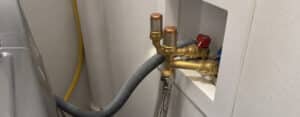
Some newer homes have a second shut-off where the supply enters the building, often in a laundry or a wall cupboard near the front. Quicker to reach than the street, and worth knowing about.
Which Valve to Turn, and Which One Not To
This is the part that catches people out.
There is a valve on each side of the meter. Only one is yours.
The valve on the road side, between the meter and the street, belongs to Sydney Water. Leave it alone. Damaging it is a problem you do not need on top of the one you have.
The valve on the house side, between the meter and your property, is the one you want. It controls water to everything on the property.
If you are unsure, the house side is the one pointing away from the street.
Turning It Off, Properly
- Turn it clockwise. Righty tighty. If it is a lever rather than a tap, it is off when the handle sits across the pipe rather than in line with it.
- Turn it slowly and firmly until it stops. Do not wrench it the last bit.
- Open a tap inside at the lowest point you have, such as a laundry tub or an outside hose tap. It will run for a few seconds and stop. That drains the pressure and whatever is still sitting in the pipes.
- Check a second tap somewhere else in the house to confirm the whole property is off, not just one branch.
One thing before you drain the system down: if you are emptying the pipes and you have a storage hot water unit, switch it off at its power point or isolation switch first. Heating a tank that has been drained will damage it.
If the Tap Won’t Move
Common on older properties, where the valve has sat untouched in damp ground for twenty years.
Do not force it. A seized brass valve can fracture, and then you have an uncontrolled leak at the boundary as well as the one inside. This is the single most common way a bad night gets worse.
What to do instead:
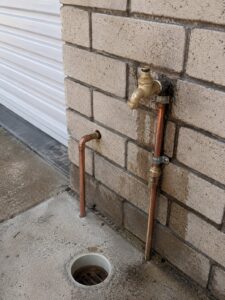
Isolate closer to the problem. Most toilets, basins, sinks and hot water units have their own small shut-off valve at the wall or under the fixture. If you know which fixture is the problem, that valve stops it without touching the mains, and it is faster than walking to the boundary.
Call Sydney Water on 13 20 90. In a genuine emergency they will attend and operate the valve on their side. Staffed around the clock and free.
Call a plumber. A seized isolation valve is a straightforward replacement, best done before the next emergency rather than during one. If a pipe has already failed, that is a burst pipe repair and the valve gets done at the same visit.
Seized valves are one of the predictable problems on properties built before about 1970, along with everything else covered in plumbing problems in older Sydney homes.
Apartments, Units and Townhouses
Worth sorting out in advance, because the answer differs between buildings.
Look for your own isolation valve first. Most units have one serving just that unit, so you can shut your water off without affecting anyone else. It may be in a service cupboard, in the laundry, on a balcony, or in a riser cupboard in the corridor.
Townhouse complexes often have a sub-meter for each dwelling, in a box near your own front boundary, set up like a house.
If you cannot find one, contact building management or strata. Shutting a shared riser affects your neighbours and needs coordinating.
If you rent, ask now. A one-line email to your property manager asking where your unit’s isolation valve is, before you ever need it.
Water off but still leaking?
Call R&G on 0461 330 531. Water that keeps coming after the mains is closed is draining out of the system rather than still arriving, and that tells us where to look. $0 call-out fee, 24 hours.
Do It Now, Not in an Emergency
Two minutes on a dry day, and the best-value plumbing task there is.
- Find the meter box and clear the lid so it opens easily.
- Check it actually turns. Close it, confirm a tap inside stops, then open it again. If it is stiff, replace it now rather than discovering it is seized later.
- Photograph it and show everyone in the house. The person who finds the leak is not always the person who read this.
- Note the fixture valves under the sinks and behind the toilets while you are at it.
Once the water is off, what you do in the next thirty minutes is what decides the damage.
Frequently Asked Questions
Which way do I turn the water main off?
Clockwise on a tap-style valve. On a lever-style ball valve, it is off when the handle sits across the pipe rather than along it. Always confirm by checking a tap inside the house.
Can I turn the water off from inside the house?
Some newer homes have a second shut-off where the supply enters the building, often in a laundry or a cupboard near the front. Older properties usually do not, and the meter at the boundary is the only whole-property option.
Is it safe to leave the water off overnight?
Yes, and it is often the right call while you wait for a plumber. If it will be off for longer, switch off a storage hot water unit at its power point, and remember that toilets will not refill once the cistern is empty.
The meter is still spinning with the water off. What does that mean?
If the house-side valve is properly closed and the meter is still moving, water is passing the valve, which usually means it is not sealing. If the meter moves with every tap in the house turned off but the valve open, you leak somewhere on the property, and that is worth investigating.
Seized tap, or water you cannot stop?
A stuck isolation valve is a short job on a dry afternoon and a serious problem at midnight. We replace them, and we come out when one fails. $0 call-out fee, fixed price before any work starts, across the North Shore, the Hills and Western Sydney. See how we handle emergency plumbing across Sydney.