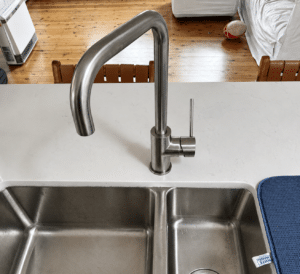
If your kitchen sink gurgles when the dishwasher drains, the two are sharing a waste line, and that line is narrowing. The dishwasher pumps a large volume of water into the same pipe your sink uses. When the pipe is partly restricted, the air that water displaces has nowhere to go except back up through the sink.
The dishwasher is not causing the problem. It is revealing one that was already there.
Quick answer
- The sound is air, not water. It is being forced back through the sink trap because it cannot get past a restriction.
- The restriction is almost always grease. Kitchen lines narrow gradually from the pipe wall inwards.
- It will not clear itself. The gurgle is the stage before the blockage.
- Chemical drain cleaner makes a grease blockage worse, not better. See below.
Why the Dishwasher Is What Triggers It
A sink drains under gravity, at whatever rate the tap runs. A dishwasher holds its wash water, then pumps ten to fifteen litres out in a short burst under pressure.
That burst fills the bore of the pipe and drives a column of air ahead of it. In a healthy line, the air escapes up the vent that runs to the roof, and you hear nothing.
In a narrowed line, it cannot. The air takes the only other route available, which is up through the water sitting in your sink trap. That is the gurgle.
So the dishwasher is a stress test on the pipe. Your sink alone never moves enough water fast enough to expose the problem, which is why it seems fine right up until it is not.
Is It the Dishwasher, the Sink, or the Line They Share?
Three different faults produce a similar noise. This separates them.
| What you observe | Where the problem is |
|---|---|
| Sink drains freely on its own, but gurgles during the dishwasher cycle | The shared branch line is partly restricted. The commonest case by far |
| Sink is also slow to empty a full bowl | Restriction is closer in, at the trap or the first metre of pipe |
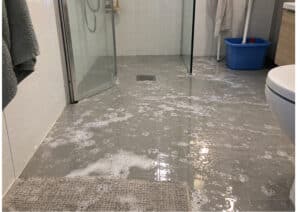
| Dirty water appears in the sink bowl during the cycle | The branch is significantly blocked, not just narrowed. Stop running the dishwasher |
| Dirty water sits in the bottom of the dishwasher after a cycle | Usually the drain hose loop rather than the pipe. See below |
| A toilet, shower or basin in another room also gurgles | Not a kitchen problem. That is the main line, and it is more urgent |
The Grease Layer Nobody Sees
Kitchen lines fail differently from bathroom lines, and the difference is why they keep failing.
Fat, oil and cooking residue go down the sink warm and liquid. Within a metre or two they cool, and what was liquid becomes a soft solid on the pipe wall. Detergent emulsifies some of it briefly, which just carries it further along before it sets.
The layer builds from the wall inwards. A 40mm branch in service for fifteen years can be down to half its bore without a single dramatic event, and the surface it leaves is rough rather than smooth, so it starts catching coffee grounds, rice and pasta starch.
That is why kitchen blockages are gradual and recurring rather than sudden. Nothing fell in. The pipe simply got smaller, and the dishwasher was the first thing to notice.
What About the Air Gap and the High Loop?
Your dishwasher’s drain hose should rise to the underside of the benchtop before dropping to its connection, or terminate at an air gap fitting. That loop stops wastewater from the sink siphoning backwards into the machine.
If the loop has slipped down, or was never installed properly, two things happen: you get gurgling, and you get dirty water sitting in the base of the dishwasher after a cycle.
The distinction is worth making before you call anyone. Gurgling with a clean, empty dishwasher points at the pipe. Gurgling with standing water in the machine points at the hose.
What You Can Check in Five Minutes
Four things, no tools beyond a bucket.
- Fill the sink, then pull the plug and time it – A healthy branch empties a full bowl in well under a minute, with a clean vortex and no gurgling. Slow and hesitant means the restriction is already significant.
- Look under the sink at the dishwasher hose. Does it rise before it drops to its connection? If it runs flat or downhill the whole way, that is your loop problem.
- Open the trap. Bucket underneath; unscrew the fitting. You are looking for a grease collar around the inside. If the trap is coated, the pipe past it is coated too, and cleaning the trap alone will buy you a few weeks.
- Run the dishwasher and listen at the sink. Note whether the gurgle comes at the start of the pump-out or towards the end. Late gurgling means the line copes until volume builds, which points to a partial restriction rather than a near-blockage.
Why Chemical Cleaners Make It Worse
Caustic drain products work by generating heat and attacking a thin surface layer. On a grease deposit, you soften the face of it; some releases, it travels a short distance into a colder section of pipe, and it sets again. You have not removed the blockage. You have moved it further from access, often denser than it was.
You have also left a pipe full of caustic standing water, which is a hazard for whoever opens that line next. Repeated use is hard on older PVC joints and chrome traps too.
To be fair to the category: enzyme and bacterial maintenance products are a different thing entirely. They are reasonable as ongoing prevention on a clean line. They will not clear an established grease blockage, and no honest plumber will tell you otherwise.
What Actually Clears It, and Why Jetting Beats Snaking
An electric eel or drain snake is the right tool for a solid obstruction or for roots. It works by boring through.
On a grease-lined kitchen pipe, boring through is the wrong outcome. The cutter opens a channel down the middle of the deposit, flow returns, and the job looks finished. The layer is still on the wall, still rough, still catching things, and you are usually back within six to twelve months.
High-pressure water jetting does the opposite. A rotating nozzle scours the pipe wall itself and takes the line back to something close to full bore, which is the only result that actually lasts on a kitchen branch. It is the reason we reach for a jetter rather than an eel on a blocked kitchen drain almost every time.
A camera run afterwards confirms the bore is genuinely restored, and shows whether the line has a sagging section holding grease. If it does, clearing it is a holding action and the real answer is a drain repair.
Sink gurgling every time the dishwasher runs?
Call R&G on 0420 146 747. We will tell you on the phone whether it sounds like a hose loop you can fix in ten minutes or a line that needs jetting. $0 call-out fee, and a fixed price before any work starts.
Frequently Asked Questions
Can I keep using the dishwasher while it gurgles?
If the sink stays clean and empty during the cycle, yes, for now. If dirty water comes up into the sink bowl, stop. At that point, the line is close to blocked, and each cycle is pushing wastewater into a pipe that cannot take it.
Why does it only gurgle sometimes?
Grease is temperature sensitive. The deposit is softer after a hot wash and firmer on a cold morning, so the same pipe passes water differently through the week. Intermittent gurgling is still a narrowing line, just one that has not closed yet.
How often should a kitchen line be cleared?
There is no schedule that fits every house, and anyone selling you one is guessing. What matters is the interval: if it needed clearing two years ago and it needs clearing again now, the last clear did not restore the bore, and the method should change rather than just repeat.
Is a gurgling kitchen sink an emergency?
No, and it is worth saying so plainly. It is the warning stage, which makes it the cheapest point to deal with it. It becomes urgent when waste starts appearing in the sink, or when fixtures in other rooms join in.
Get the line cleared properly, once
R&G clears kitchen lines with high-pressure jetting and confirms the result on camera, so you are not booking the same job again next winter. Licensed and insured, covering the North Shore, the Hills and Western Sydney, with a $0 call-out fee and a fixed price before any work starts.