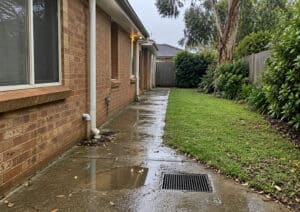
Water running across a driveway or path instead of draining away is a surface problem, not an underground one. The water never reaches a drain, so nothing below ground gets the chance to fail.
That changes what you should be looking at. Most people go hunting for a blockage. The answer is usually visible from where you are standing: a grate packed with silt, a fall that was never right, or a drain that got paved over years ago.
Quick answer
- There is a grate, and it is full: clear it. The most common cause and a ten-minute job
- There is a grate, and it is clear: the line leaving it is blocked
- There is no grate anywhere: the surface has no drainage, or it was paved over
- Water runs towards the house or garage: deal with this one first, whatever else is going on
Surface Water Is a Different Problem From a Flooded Yard
Worth separating, because the two get confused and they need different work.
A waterlogged lawn or garden bed is about what is happening below ground: a blocked pit, a broken line, a downpipe that goes nowhere. Our guide to backyard flooding after rain covers that.
Water sheeting across a driveway is about what is happening on top of it. Hard surfaces absorb nothing, so every drop has to be carried away by the shape of the surface itself. If the shape is wrong, or the thing meant to catch it is blocked, the water keeps going until it meets something absorbent or something you would rather it did not, such as your garage.
The Six Causes, Roughly in Order
1. A blocked channel or strip drain. The long grated channel across a driveway or at a garage entrance. Leaves, silt and mulch fill it faster than anyone expects under a Sydney tree canopy. Lift the grate and look.
2. The line leaving the channel is blocked. The channel is clear, but water still sits in it, which means the pipe running from it to the discharge point is the problem: silt, roots, or a crushed section under the driveway.
3. There is no drainage on the surface at all. Common where paving, a carport or an extended driveway was added later without drainage designed in. It worked when that area was lawn, because grass absorbs. Concrete does not.
4. The fall is wrong, or there is none. Paving needs a consistent slope towards a drain or the kerb. Laid flat, it holds water in every low spot. Laid towards the building, it delivers water to the worst possible place. This is the cause that no amount of drain clearing will fix, which is why it gets paid for twice.
5. Paving was laid over an existing drain. A grate or pit that was there twenty years ago is now under pavers or concrete. The drainage exists and has simply been sealed off. More frequent than you would think, and often identifiable from an old site plan.
6. Ground level has risen around the edge. Turf top-dressing, garden beds and mulch build up over the years until the soil sits above the paved edge, forming a low wall that traps water on the hard surface. Free to fix and rarely suspected.
One more worth checking while you are out there: gutters and downpipes. A downpipe discharging onto a path, or a gutter overflowing above it, puts far more water on that surface than rain alone, and it looks exactly like a drainage fault.
Why It Matters More Than It Looks
This is the part that justifies acting on what feels like a nuisance.
Water against the building. Repeated saturation around footings and slab edges is a genuine structural concern in Sydney, particularly in the western suburbs and the Hills where reactive clay soils swell when wet and shrink when dry. That movement is what cracks slabs and brickwork, and it happens gradually enough that nobody connects it to the puddle by the back door.
Undermining the paving itself. Water running the same line every downpour washes out the bedding sand or sub-base beneath. Pavers sink, concrete cracks, and the low spot deepens, sending more water the same way.
Water getting inside. A driveway falling towards a garage is one storm away from a flooded garage, and a path falling towards a doorway eventually finds a threshold.
Persistent damp near the structure is not something you want around a Sydney house for reasons beyond plumbing.
None of it is urgent this week. All of it gets more expensive the longer the same water runs the same way.
What to Check Yourself
Watch it while it rains, if it is safe to be out there. Where does the water arrive, and where is it going? The most useful thing you can do, and it cannot be reconstructed afterwards. Take a video.
Lift every grate you can find. Channel drains, pits, anything grated. Packed with debris means you have found it.
Pour a bucket of water on the dry surface at the spot where it pools. Watch which way it runs. That tells you the fall in five seconds without any tools.
Walk the edges of the paving. Is the soil, turf or mulch sitting higher than the hard surface? If so, the water has nowhere to go.
Follow the downpipes. Do they connect into a pipe in the ground, or stop short and discharge onto the surface?
What not to do: do not cut a channel to send water towards a boundary. Directing runoff onto a neighbouring property is not permitted, and it turns a drainage problem into a dispute.
Grate is clear, and it still pools?
Call R&G on 0461 330 531. If the channel is clear, it is either the line below it or the fall, and those are two very different jobs. Worth knowing which before anyone quotes. $0 call-out fee.
What Actually Fixes It
Four remedies, and which one you need depends entirely on the cause above.
Clear and maintain the channel. Free, and the answer more often than people expect. If it fills every autumn, that is a seasonal task, not a fault.
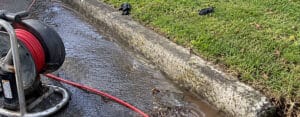
Clear or repair the line below it. Jetting removes silt and root matter, and a camera afterwards shows whether the pipe is sound or crushed. On a line under a driveway, that is worth knowing before anyone lifts concrete, and it is what decides between a clean and a drain repair.
Install drainage where there is none. Install a channel drain across the low point or at a garage threshold, connected properly to the stormwater system rather than discharging onto the next surface. This is the usual answer for paving added without drainage.
Regrade the surface. The most disruptive and sometimes the only honest answer. If the fall is wrong, no drain added downstream of the problem will fix water that is already going the wrong way.
A plumber should tell you which of the four you are dealing with before quoting any of them. More on how we find and clear blocked stormwater drains across Sydney.
Frequently Asked Questions
Is water pooling on a driveway actually a problem?
On its own, no. Repeatedly, in the same place, next to a building, yes. The damage is to the bedding under the paving and to the soil around the footings, and both happen slowly enough that people stop noticing the puddle long before they notice the cracking.
Can I add a drain where the water sits?
Sometimes, and it is often the right fix. But a drain only works if water reaches it and can leave it, so it has to sit at the true low point and connect to somewhere that can take the flow. A channel drain that discharges onto the next surface along has moved the problem rather than solved it.
Why did this start after we had the paving done?
Two usual reasons. The new surface absorbs nothing where the old lawn or garden did, so the same rain now has to be carried away rather than soaked up. Or the work changed levels, either by altering the fall or by burying a drain that was already there.
Whose responsibility is the drainage on my driveway?
Yours. In NSW, you are responsible for stormwater on your property all the way to the legal point of discharge, which is usually the kerb at the front. The council maintains the network beyond that point.
Find out whether it is the drain or the fall
Those are two different jobs at two very different prices, and clearing a drain will not fix a surface running the wrong way. We work out which before quoting either. $0 call-out fee, fixed price before any work starts, across the North Shore, the Hills and Western Sydney. See how we handle drains and stormwater across Sydney.